
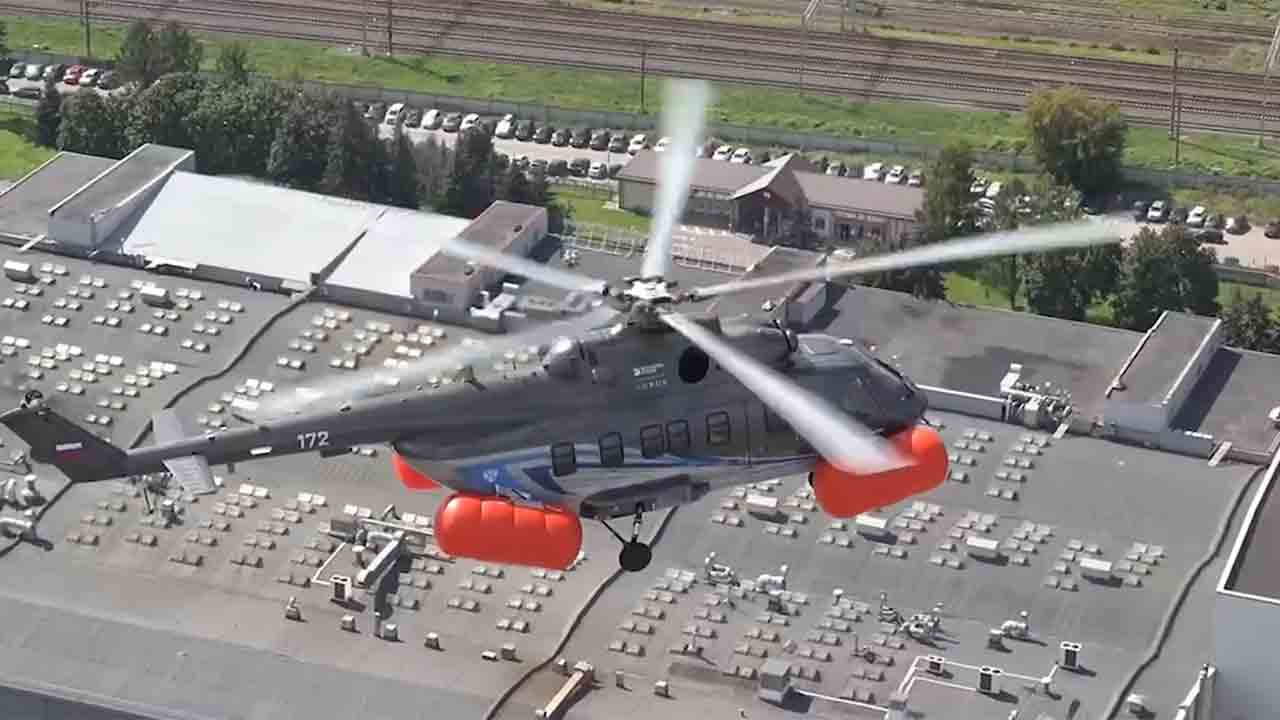
The Mi-171A3 helicopter, developed for offshore missions and now in a configuration fully based on Russian components, has completed its certification process and received official authorization to operate over large bodies of water.
The announcement was made by Rostec and the Russian Helicopters holding, which highlighted the milestone as a significant step forward for Russian aviation focused on complex maritime operations.
According to Rosaviatsiya, seven major approvals for changes to the aircraft’s design were issued. The most relevant stage was the certification of the convertible offshore configuration, which now allows the Mi-171A3 to carry out flights in maritime areas far from the coast, expanding its use in missions supporting oil and gas platforms, logistics transport, and operations in hard-to-access environments.

According to the released data, the Mi-171A3 has demonstrated safety for operations far from the coastline and under demanding operational conditions.
The test campaign included flights in mountainous regions of Kabardino-Balkaria, testing in a polar environment in the Salekhard region, and landings on a drilling platform in the Caspian Sea—scenarios considered essential to validate its real-world application in offshore missions.
The aircraft was also certified for passenger and cargo transport, instrument flight in adverse weather conditions, and takeoff and landing operations in high-altitude areas. According to Russian Helicopters, more than 500 flights were carried out during the certification process, including simulations of abnormal situations and evaluations under extreme weather conditions.
One of the program’s main highlights was the validation of the first Russian impact-resistant fuel system structure. According to tests, the components were able to withstand high shock loads, reducing the risk of leakage and fire in the event of an emergency landing. For the offshore segment, this type of solution is considered essential, as aircraft of this profile operate over long stretches of open sea and under stricter safety requirements.

Another key element of the Mi-171A3 configuration is its ability to perform a forced water landing in sea conditions with waves up to level 5. In this situation, four floats installed on the sides of the fuselage are automatically deployed to keep the aircraft stable on the water.
+ Watch the video of the float tests on the Mi-171A3
The helicopter is also equipped with life rafts and other features aimed at survival and evacuation during prolonged missions over the maritime environment.
Source and images: Rostec. This content was created with the help of AI and reviewed by the editorial team
